Premise
In order to meet the societal challenges of the future, it is important that Sweden remains a strong research nation that can assert itself in competition with other countries. At the same time, it can be seen that the share of the population undergoing postgraduate studies is decreasing. This means that foreign doctoral students and researchers may in future play an increasingly important role in research and higher education in Sweden. In an analysis from 2019, the Swedish Higher Education Authority found that as many as 62 per cent of foreign doctoral students left Sweden after a review three years after graduation.
Among other things, it has been pointed out that the changes to the Aliens Act (2005:716) implemented in 2021, which set stricter requirements to be granted a permanent residence permit, may mean that fewer foreign doctoral students stay in the future.
The migration law framework for researchers and doctoral students should be amended
The migration law framework should therefore undergo a change in a direction that strengthens the image of Sweden as an attractive research nation for both researchers and doctoral students, within the framework of the Student and Researcher Directive, while still being well-balanced so that it does not lead to misuse of residence permits (use on the wrong grounds or for long periods of periods of idleness).
Suggested amendments to the law
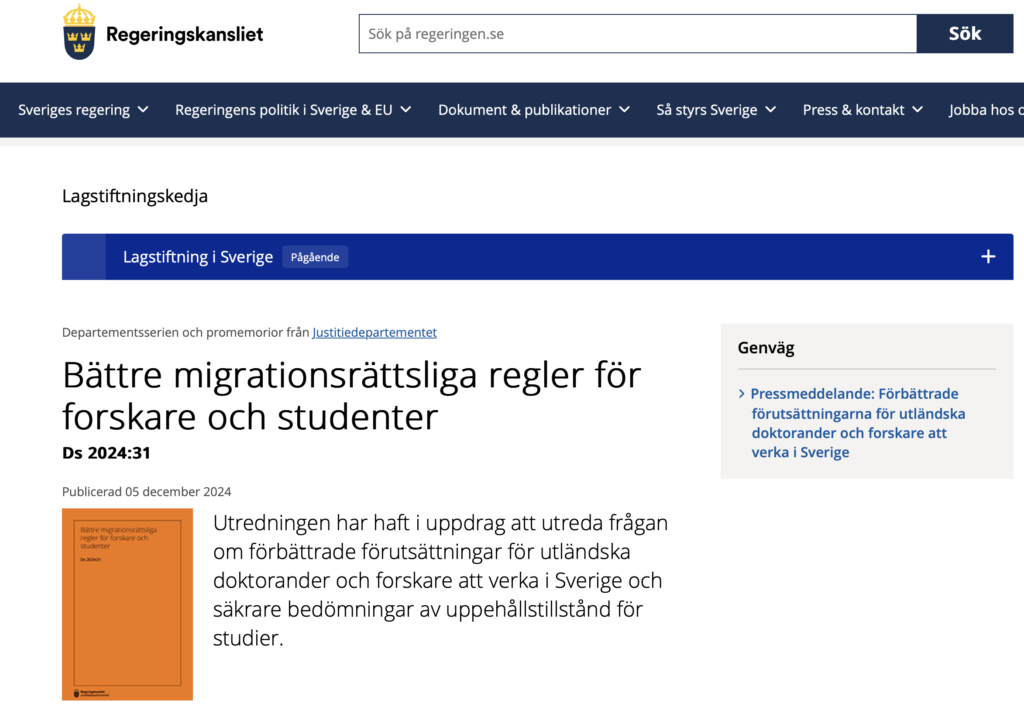
What follows are the proposals in the governmental investigation (published December 2024) that are relevant to doctoral students. They have not yet passed as law and it is not guaranteed that all of them will. A separate post will follow when the equivalent law amendments have been passed.
1) Doctoral students shall be granted a residence permit for research
Proposal: A doctoral student should be able to conclude a hosting agreement with a research organisation and apply for and be granted a residence permit for research or research on mobility for a longer stay.
Assessment: It should continue to be possible for a doctoral student who has not concluded a hosting agreement to apply for and be granted a residence permit for studies in higher education or for visits.
Under Swedish migration law, a foreign national who is in a doctoral programme is considered to be a student. A doctoral position based on a salaried position is considered, from an immigration law point of view, a form of employment created to give the doctoral student the possibility to support themselves during their studies – as the person employed as a doctoral student must primarily devote themselves to their own education. Doctoral students can therefore be granted a residence permit for studies, but not for research.
The fact that doctoral students cannot apply for a residence permit for research means that they have fewer opportunities for mobility than would otherwise be the case, and that their accompanying family have less favourable conditions in some respects.
2) Improved possibilities for permanent residence permits
2.1) A clarified income requirement for permanent residence permit
The requirement of sustainable livelihood as a precondition for permanent residence permit has caused problems for researchers and doctoral students. Anyone who wants a permanent residence permit in Sweden must according to Chapter 5. 7 § 1 of the Aliens Act, show that they can support themselves. According to the preparatory works, the purpose of the maintenance requirement is that the foreign national, in order to qualify for a permanent residence permit, should not have such a low income that they need support to cover the costs of their accommodation and subsistence.
The way to assess the duration of dependency under this legal position posed major problems for researchers and doctoral students. It has also been widely criticised by, among others, trade unions and professionals in the sector for not being adapted to the the forms of employment that exist at universities and colleges, where fixed-term contracts are common and research is often funded through fixed-term external grants. Furthermore, doctoral positions are temporary and doctoral contracts are usually granted for one year at a time. Even after the doctorate, short-term contracts are often offered for specific research projects or probationary positions. Furthermore, the dependency requirement has been criticised on the basis of current processing times for residence permit cases, which in this interpretation of the income requirement may mean that a foreign national who at the time of application had an employment of sufficient duration to qualify for a permanent residence residence permit, nevertheless risks having their application rejected because the assessment is made on the basis of the circumstances that are relevant at the time. It has also been criticised that handling requirement in this way risks leading to unequal treatment of different applicants, as different processing times can give different results.
Since the application should allow for flexibility and that there should be no fixed time limit, but rather an overall assessment of the concrete and individual circumstances of each individual case, a foreign national who has, for example, obtained a a fixed-term career development position can now qualify for a permanent residence permit. The lack of such possibilities has been the main criticism.
The provisions should also clarify that the assessment should also take into account whether the foreign national has had sufficient capacity to maintain themselves for a long period of time before the examination.
2.2) It should also be possible to fulfil the dependency requirement for certain financing other than income from employment
As set out in the previous section, the purpose of the provision requirement is to ensure that a foreign national, in order to obtain a permanent residence permit, must not have such low income that they need support to cover the costs of accommodation and subsistence. For those foreigner nationals who have funding in the form of grants, the application of the dependency requirement is problematic.
Migrationsverket has also applied this requirement in such a way that income from scholarships, among other things, is not considered as income from employment or business activity. And therefore, other income such as various forms of grants, scholarships or returns on capital cannot be taken into account.
3) Researchers and doctoral students should have better opportunities to be granted a permanent residence permit
Proposal: A foreign national may be granted a permanent residence permit if they have held for at least three years a residence permit for research, research for mobility for studies at doctoral level or an EU Blue Card issued by Sweden. The conditions for obtaining a permanent residence permit shall be clarified so that the provisions explicitly state that a permanent residence permit may be granted to a foreign national who has held a residence permit for a total of four years during the last seven years. This permit should have been for work, research, long-term mobility research or studies for the purpose of doctoral education, or an EU Blue Card, ICT permit, ICT permit for long-term mobility or seasonal work permit.
An application for a permanent residence permit may be made from within the country.
The fact that doctoral studies constitute a basis for permanent residence permit has its background in that doctoral students are granted a residence permit for studies. Since doctoral students are considered to have studied, and not working, doctoral students could not qualify for permanent residence permits in the way that labour immigrants could. Doctoral studies were introduced as a basis for permanent residence permit in 2014 because doctoral students, who often spend long periods in Sweden and gain a real connection with the Swedish society, did not have similar opportunities.
The possibility of a permanent residence permit should be introduced after three consecutive years of research or doctoral studies
An important part of achieving this is to consider how the regulatory system can be designed to give these foreigner nationals good opportunities to plan their future in the country after the research project that brought them to Sweden has ended. This raises the question of whether researchers and doctoral students should be granted permanent residence permit earlier than is currently the case. After three years a doctoral student will have completed the majority of their studies at doctoral level. Furthermore, after three years, the individual may be considered to have established and integrated into society, contributed to the development of society and gained a such a strong connection to the Swedish labour market that should qualify the foreign national for a permanent residence permit.
4) Revocation of a temporary residence permit in favour of a permanent residence permit
Proposal: A temporary residence permit shall be revoked at the foreign national’s request, if the foreign national applies for and is granted a permanent residence permit during the period of authorisation. The same shall apply if the foreign national has an EU Blue Card, ICT permit, ICT permit for long-term mobility or a permit for seasonal work permit.
The possibility to revoke temporary residence permits in favour a permanent residence permit on any ground would risk leading to overly generous rules. If there were no obstacles to repeatedly and at any time of submitting an application for a permanent residence permit, it could also lead to Migrationsverket having to process a large number of applications even though the conditions for a permanent residence permit are not met. Such an arrangement is not desirable.
The possibility to revoke a temporary residence permit should therefore be limited to certain types of authorisation. The proposals in this memorandum are aimed at improving the conditions for researchers and doctoral students to come to and work in Sweden. It is considered to be urgent that a researcher or doctoral student who wants to settle in Sweden can apply for a permanent residence permit as soon as they fulfil the deadlines for this.
5) Specifically on family members' access to residence permits
Assessment: No legislative amendments are needed to allow family members of researchers and doctoral students to be be granted a residence permit.
6) Longer residence permit after completing research or completed doctoral studies
Proposal: Residence permit to seek work or investigate the conditions for conducting business activities in Sweden after completing research or doctoral studies should be granted for a period of 18 months.
Anyone who has completed research or doctoral studies in Sweden can nowadays apply for a temporary residence permit to look for work or examine the conditions for conducting business activities in the country, a so-called job seeker’s permit (jobbsökartillstånd). Job seeker permits are currently granted for a period of one year.
It can now be concluded that even the one year for which a jobseeker’s permit can be granted may be a short time to give foreign researchers and doctoral students the best possible conditions to establish themselves in Sweden. For example, a one-year permit is not always sufficient for a new doctoral graduate to find a relevant position here, partly because positions are highly competitive. The fact that research in Sweden is largely funded externally also means that it can take a long time before a particular planned research project can be initiated.
7) Possibilities for national visas in certain cases
A foreign national should be able to apply for a national visa when travelling abroad if 1) the trip is related to the research or studies at the research level that they are carrying out or have carried out, or 2) the trip is made to visit the foreign national’s family abroad. The corresponding possibility to be granted a national visa should be introduced for a foreign national who has applied for a residence permit or an extended residence permit as a family member.
For researchers and doctoral students, it is justified and appropriate to introduce the possibility of a visa – at least if the foreign national needs one in order to be able to enter Sweden after a trip abroad that is related to the research or studies at the research level. A possibility of a national visa in such cases should be introduced both for an application for the extension of an existing residence permit for research or studies at doctoral level and when changing between such residence permits. Such a possibility should also be introduced for those foreigner nationals with job seeker’s permit who apply for a residence permit from within the country for research or doctoral studies within the period of validity of the previous permit and the conditions for that permit fulfilled.
It is of course debatable whether it is appropriate to introduce a possibility of a visa in more situations than suggested above. In this context it should also be emphasised that more applications for national visas would be processed in competition with all the other authorisations that Migrationsverket has to handle. Thus, the possibilities for national visas that are introduced to help some foreigner nationals may have negative consequences for others, whose applications cannot then be processed as quickly or efficiently. In this context, it can also be noted that labour migrants do not have the possibility to be granted a visa for private travel – such as for family reasons. For these reasons, it could be argued that there is a case for – at least initially – only allow visas in cases where they are deemed most needed and not open up for national visas in too many situations.
A family member of a researcher or doctoral student should be able to apply for a national visa, if they need one in order to enter Sweden after a trip abroad which is either related to the research or doctoral studies or to visit the foreign national’s family abroad. In this way a family member of a researcher may, for example, accompany the researcher on a travel related to the research, for example to international conferences, or travelling home for various family matters.
8) More possibilities to change residence permits after entry to Sweden
Proposal: An application for authorisation to be submitted and granted from within the country if there are exceptional reasons. Family members of foreign nationals with a residence permit, who have either completed studies equivalent to 30 higher education credits or completed one semester of postgraduate studies, may apply for a residence permit for research or studies in higher education that relate to doctoral studies from within the country. Foreign nationals with a residence permit may apply for a residence permit from within the country.
As a general rule, a residence permit must have been granted before entering Sweden. Since it is only in exceptional cases that an application can be made after entry, a foreign national who has already arrived here with a residence permit usually needs to leave the country in order to change the basis to another residence permit. There are several exceptions which allow residence permits to be applied for from within the country. Nevertheless, situations may arise where a foreign national already residing in the country cannot obtain a new residence permit without having to leave Sweden, which can lead to difficulties for the individual.
It is appropriate to consider whether there should be more situations where it is possible to apply for a change of residence permit from within the country. Even when applying for an EU Blue Card, i.e. a residence permit issued to foreigners who have been offered highly qualified employment in Sweden or for residence permits for their family members, there is currently no possibility to submit an application from within the country for exceptional reasons.
9) In particular, for foreigners who have been granted protection under the so-called ‘mass displacement’ directive
Proposal: A temporary residence permit, at the request of the foreign national, can be revoked if the foreign national applies for and is granted a residence permit for work or to conduct business activities, for research under or for studies at a doctoral level or an EU Blue Card. The same shall apply to a foreign national who applies for and is granted a residence permit as a family member of such a foreign national. In these situations, a foreign national must be able to apply for the new permit from within the country.
The possibility of revocation as described above shall only apply if the residence permit has been granted as a result of Council Implementing Decision (EU) 2022/382 of 4 March 2022 establishing the existence of a mass influx of of displaced persons from Ukraine within the meaning of within the meaning of Directive 2001/55/EC or regulations issued by the Government.
The provisions on visiting researchers in the Act on the authorisation of research organisations to receive visiting researchers shall be be applied if a foreign national with a residence permit has requested their residence permit to be cancelled.
The whole investigation